

Meet Katie and Allstarr, Why We Chose Horses for This Work
Equine Therapy Retreat in Cle Elum, Washington
Read time: 6 minutes
People are usually curious about the program before they're curious about the horses. Then they meet Katie and Allstarr, and the order flips.
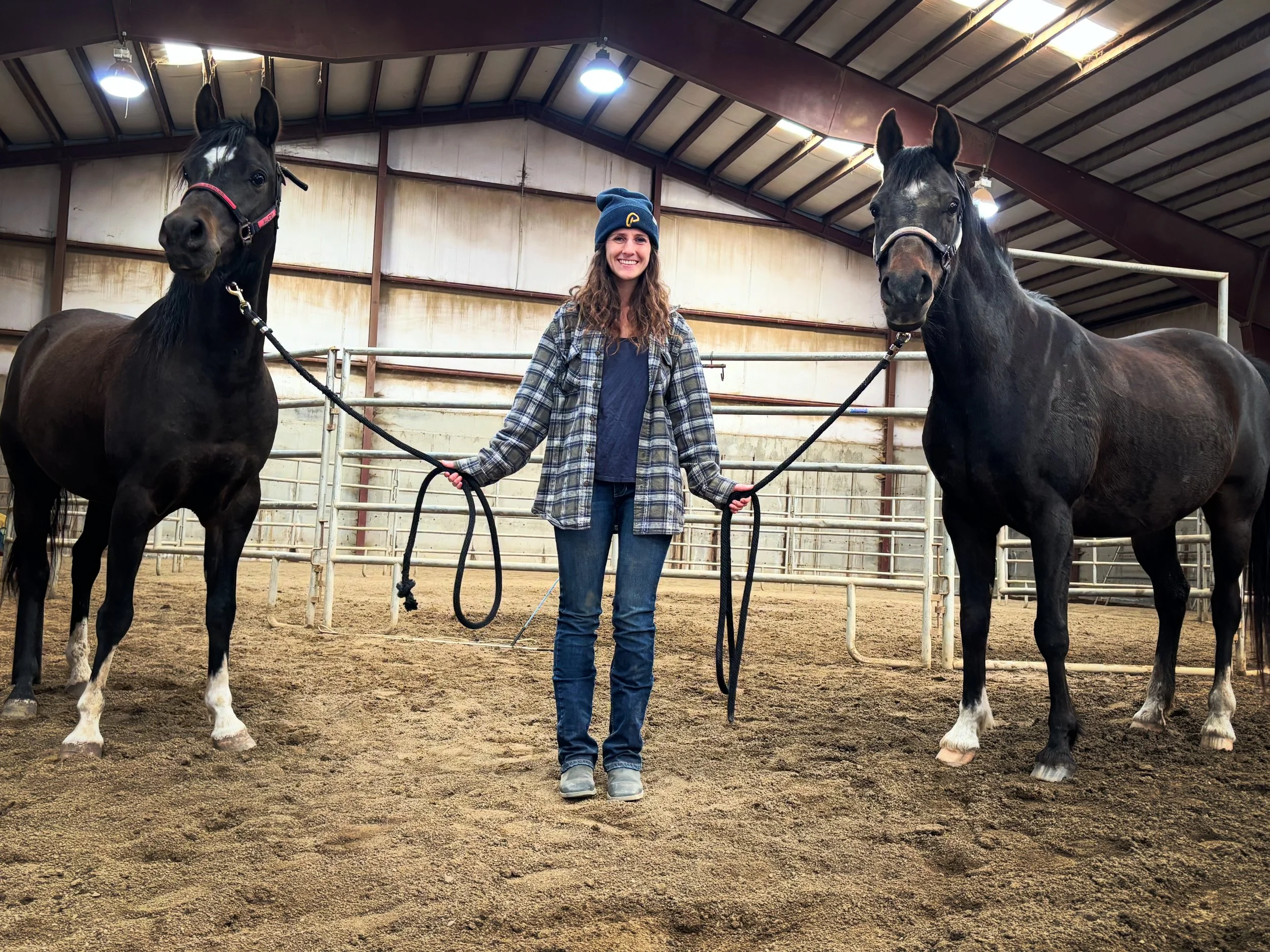
Katie is 17, a retired Arabian who spent most of her life working and is now settled into a slower, steadier chapter. Allstarr is her son, 5 years old, more playful, more curious, still figuring himself out. Both of them live at Cle Elum, Washington, a mountain setting about 90 minutes east of Seattle. They're not just two horses who happen to live at the same ranch. They're a pair with an actual relationship, and that turns out to matter more than people expect.
Why a mother and son pair
A lot of equine programs use a single horse, or a rotating group with no particular relationship to each other. We built this program around Katie and Allstarr specifically because watching a secure, established bond between two animals does something for survivors that words rarely can.
So much of trauma from sexual assault or domestic violence involves relationships that weren't safe. Attachment that came with conditions, or fear, or control. Being around two animals who trust each other completely, who communicate without conflict, who have an easy closeness that isn't about power, quietly models something a lot of survivors haven't had much exposure to. Nobody has to point it out or explain it. You just get to be near it.
Katie's steadiness
Katie's age and temperament make her an anchor for the program. She's calm in a way that isn't performative, it's just who she is after 17 years. New participants are often drawn to her first because her energy is so easy to be near. There's no unpredictability to brace for.
For survivors whose nervous systems have spent years braced for the next unpredictable thing, being near an animal who is consistently, boringly calm is its own kind of medicine. Your body starts to learn, slowly, that not everything requires vigilance.
Allstarr's curiosity
Allstarr brings something different. He's younger, more playful, occasionally a little pushy in the way young horses are, still learning his own boundaries. Working with him often brings up different material than working with Katie does.
A lot of participants find that setting a boundary with Allstarr, and having him actually respect it once they mean it, is a specific kind of empowering. He's not going to comply just because you're anxious or unsure. He responds to clarity. Learning to communicate with that kind of clarity, and watching it actually work, is a rehearsal for doing the same thing with people.
Why horses over other animals
People sometimes ask why we didn't build this around dogs, since dogs are more common in therapeutic settings and feel more immediately approachable to most people.
Dogs are wired to please. That's part of what makes them wonderful companions, but it also means a dog will often mask its own discomfort to stay close to you, the same way a lot of survivors learned to mask their own discomfort to stay safe. A dog might tolerate being approached the wrong way. A horse generally won't.
Horses require you to be honest, because they won't respond to anything else. That honesty is uncomfortable at first for people who've spent years performing okayness, but it's also exactly the skill trauma recovery requires. You can't fake your way through a session with a 1,000 pound animal who is reading your nervous system in real time.
What a first meeting usually looks like
Nobody is thrown into groundwork on day one. A first meeting is usually just standing near Katie or Allstarr, maybe offering a hand for them to approach on their own terms, noticing what comes up in your body without any pressure to do anything else.
A few things to watch for if you ever find yourself near a horse, whether here or elsewhere:
Soft, relaxed ears usually mean the horse is calm and receptive
Ears pinned back or a raised head usually mean the horse is alert or unsettled
A lowered head and slow blinking often signal trust and relaxation
Turning away or stepping back is information, not rejection
Learning to read these signals is part of the work itself. It teaches you to pay attention to subtle cues, which is a skill a lot of survivors lost touch with after their instincts were overridden or ignored during their trauma.
If you want to meet them
Katie and Allstarr are at the center of the Horses and Healing program at Cle Elum, Washington. If you're a survivor of sexual assault or domestic violence considering this work, meeting them is often the moment the program stops being an idea and starts being real.
Follow @Lets_Talk_Consent on Instagram and TikTok for more of their story, and reach out if you'd like details on upcoming retreat dates.